
Why Analysts Need Your Briefing — Even If You’re Not a Client
The pay-to-play myth doesn't just misrepresent analyst firms. It causes startups and other non-clients to miss opportunities to shape analyst perceptions and buyer awareness.

June 6, 2026 · Analyst Business Model #2 · Free
AR Intelligence: Snapshot
There is – even to this day – a widespread belief that analyst firms are pay-to-play and that vendors must be clients in order to brief analysts. The pay-to-play myth persists because analyst firms do sell advisory services, inquiries, events, and subscriptions. Outsiders often assume that commercial relationships determine research coverage. In reality, reputable firms separate research quality from commercial engagement because their credibility depends on it.
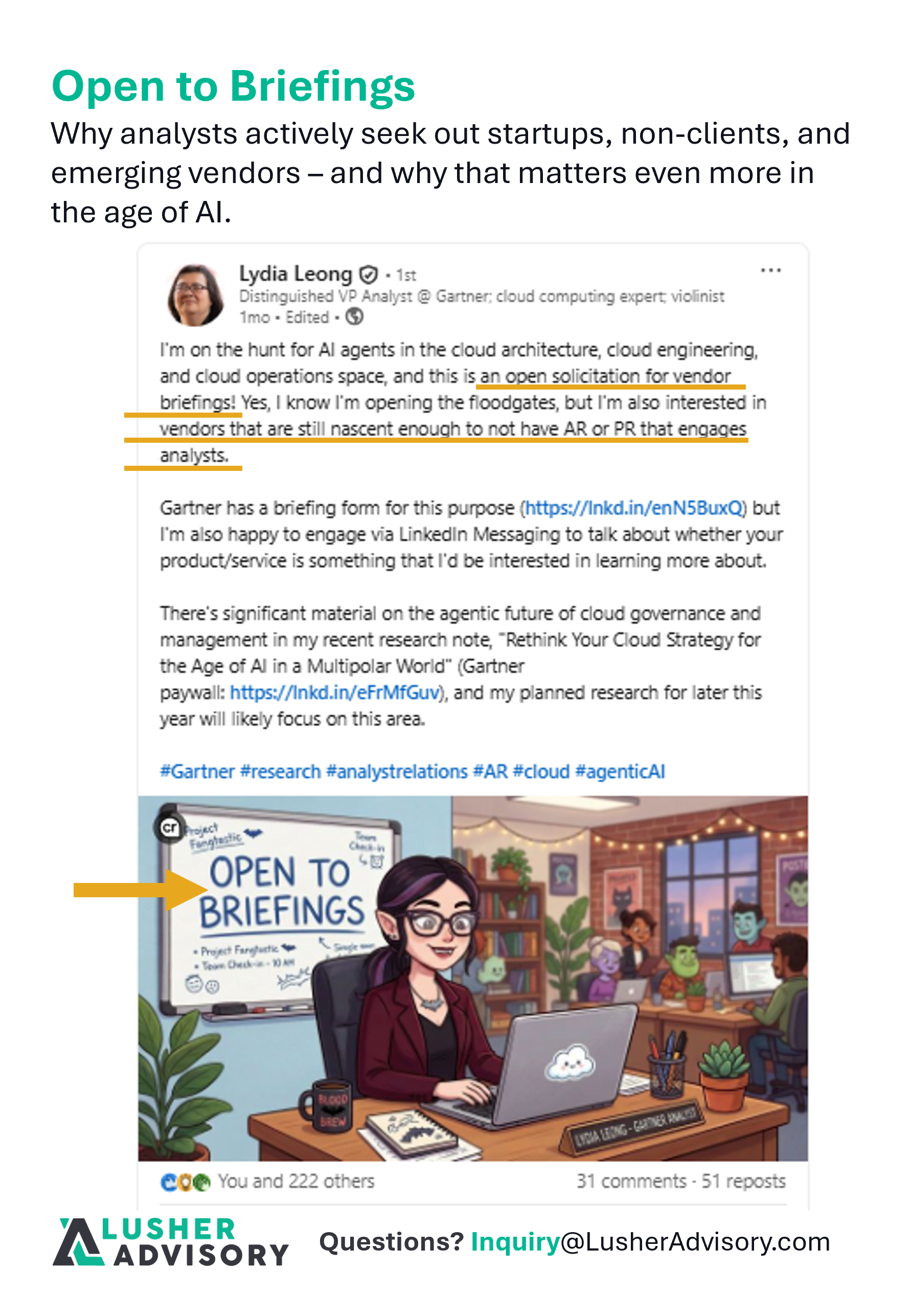
Lydia Leong, Distinguished VP Analyst at Gartner, recently posted something that every AR professional, startup founder, and vendor executive should read. She put out an open solicitation for vendor briefings in AI agents, cloud architecture, cloud engineering, and cloud operations — and explicitly welcomed:
“I’m also interested in vendors that are still nascent enough to not have AR or PR that engages analysts.”
That’s not a one-off. That’s how serious analysts operate.
Leong’s post immediately reminded me of one of the most important lessons I learned during my years as an analyst: the best market signals often come from companies that aren’t clients.
Dig Deeper:
Why do analysts want briefings from all vendors, especially non-clients and startups?
Why does an analyst’s credibility depend on briefings from vendors who will never write a check?
Why did a Gartner analyst leave the East Coast HQ for a three-person office in Silicon Valley — and what does that tell you about how research actually works?
How does AI reinforce the need for analysts to be briefed by all vendors, not just clients?
An Insider’s Perspective - Analysis That Led the Market
I can speak to this from the analyst side. Throughout my career — at Gartner, Ovum, and Lusher Advisory — I actively sought briefings from non-clients and startups. In 1994, I made a decision that puzzled more than a few colleagues: I left Gartner’s corporate headquarters, where more than 80% of analysts worked, in Stamford, Connecticut, to join the firm’s nascent three-analyst Bay Area Research Center in Silicon Valley. When people asked why, my answer was one word: “startups.”
Emerging vendors, scale-ups, and under-the-radar companies were the early signal. I cited them and their insights in end-user client inquiries. They shaped the advice I gave CIOs. They informed every keynote I delivered.
Finding non-clients before they became mainstream wasn’t a side interest. It was the job.
Knowing who was building what – before it appeared in a press release or a funding announcement – was the difference between analysis that led the market and research that merely described it.
The Briefing Is How Analysts Do Their Job
Analyst firms don’t stay relevant by talking only to their paying clients. They stay relevant by maintaining a continuously updated picture of the market — every segment, every tier, every wave of emerging players. Briefings from non-clients are a core input to that picture.
When an analyst publishes a Magic Quadrant, a SPARK Matrix, MGI 360 Ratings, or a market landscape, the credibility of that document depends on broad market coverage. A research note that only reflects the views of paying subscribers is, by definition, a compromised research note. Reputable firms know this. Their research integrity depends on casting a wide net.
This is also why the pay-to-play myth is so corrosive. It leads companies — especially startups and growth-stage vendors — to assume they have no standing until they’re writing checks. That assumption costs them influence they could have earned for free. Lydia Leong, in a follow-up message to the author:
“I got good response from startups but not as many as I might have hoped. Several of them told me that their VCs told them that this was an opportunity they should seize.”
The response to Leong’s solicitation demonstrated the point. Leong noted that several startups told her their VCs encouraged them to respond. That’s notable. Savvy investors understand the strategic value of analyst visibility before founders do.
The AI-Era Dimension: Proprietary Data Matters More
There’s a dimension to this that goes beyond traditional research practice. In the age of AI, the non-client briefing has become an even more valuable input — and not just for the analyst. Conversations with pre-market startups, under-the-radar scale-ups, and non-client vendors represent exactly the kind of proprietary, unstructured, real-time market intelligence that large language models cannot access. It doesn’t exist in published reports, press releases, or SEC filings. It lives in the briefing room. It also lives in client inquiries, end-user conversations, and practitioner discussions.
Analyst firms that maintain broad, active briefing pipelines — regardless of client status — are accumulating a research asset that no AI system can replicate. That’s a competitive moat. And for vendors, it means that getting in front of analysts early isn’t just about influence — it’s about being part of the primary data layer that increasingly matters most to both analysts and their AI tools.
As public information becomes easier to access through AI, unique information becomes more valuable. Analyst briefings, customer inquiries, and practitioner conversations are increasingly part of the differentiated data layer that LLMs scraping public information cannot easily replicate.
This is a free AR Intelligence research note. If you know a startup founder, AR professional, marketer, or vendor executive who still believes analysts only talk to clients, please forward it.
What This Means for AR Professionals
If you’re running AR for a vendor that isn’t yet an analyst firm client, your job isn’t to wait. Your job is to get on the radar now, while the cost of entry is a well-prepared 45-minute briefing.
A few principles that hold regardless of client status:
Analysts are actively looking for you. Leong’s post is not unusual — analysts routinely put out solicitations for briefings, scan LinkedIn and tech press, and follow referrals from trusted peers. Make it easy for them to find you.
The briefing shapes the baseline. Every analyst has a mental model of your space. If you’re not in it, you’re invisible — or worse, mischaracterized by a competitor’s framing. A single substantive briefing can shift that.
Consistency compounds. One briefing establishes presence. A cadence of briefings — tied to product milestones, market moves, and new data — builds influence over time. This is true whether or not you’re spending on inquiry or advisory.
Analysts are not required to take every briefing request so make sure you position yourself as relevant to the analyst’s coverage and have interesting market intelligence to share, not just a product introduction.
Understand that the analysts are busy and might not have immediate time slots for your briefing, e.g., getting ready for an upcoming conference or the annual signature research update. Do your homework in advance and make sure to include your timing flexibility in the briefing request.
Do not try to cram every possible point into your initial briefing – take the mindset that this will be first of many interactions.
What This Means for Vendor Executives
If your company has been deferring analyst engagement until you “can afford it,” reconsider the math. The cost of a well-run briefing is internal time. The cost of being absent from an analyst’s market map when a major evaluation begins is far higher.
Gartner, Forrester, IDC, and the specialist firms are not waiting for you to become a client before they form opinions about your category. They’re forming those opinions now — from your competitors’ briefings, from press coverage, from customer conversations. The only question is whether your perspective is in the room.
Non-client briefings aren’t charity from analyst firms. They’re a research necessity — and an open door that too many vendors do not walk through.
AR Intelligence: Conclusion
Lydia Leong’s post — and her follow-up observation that she wished more startups had responded — is a useful reminder of something experienced AR professionals already know: the briefing is the foundational currency of analyst relations, and it doesn’t require a purchase order. What it requires is preparation, relevance, and the initiative to reach out.
If you’re in a space an analyst covers — and they’re actively hunting for new entrants — the door is already open. Walk through it.
Related reading:
On the flip side are vendors who should have analyst advisory contracts but hold off because they aren’t included in the firms’ signature research. This is also a mistake. See Justifying Analyst Contracts When You’re Not in the Magic Quadrant.
Subscribe to AR Intelligence
Analyst ecosystem research — same budget as Gartner, WSJ, or professional dues
AR Intelligence delivers weekly analysis of the analyst ecosystem — deeper insights, early signals, and strategic guidance you can act on immediately.
Individual: $8/month (cancel anytime), $80/year (save 17%), team plans available.
Team Plans: If your team is already sharing AR Intelligence research notes internally, you’re ready for a Team Plan. Starting at $350/year — 5 or 10 seats with bundled inquiry time. Click here for details and signup.
Bottom line: AR Intelligence is the source of intelligence and insights for all members of the analyst ecosystem. Professional subscription, not personal expense.
Need timely, actionable advice tailored to your situation?
Inquiry-by-the-Hour or Research & Advisory Services
Advisory and inquiry-by-the-hour engagements are available for organizations that want to pressure-test strategy, redesign workflows, or translate these signals into concrete decisions for 2026.
• Inquiry-by-the-hour: No retainer required, unlimited attendees
• Research & Advisory Service: Unlimited inquiry, unlimited attendees
To learn more: Sales@LusherAdvisory.com
© 2026 Lusher Advisory, LLC. All Rights Reserved.
This report is copyrighted by Lusher Advisory. Unauthorized distribution or reproduction is prohibited.
Want to share broadly within your organization? Team subscriptions and reprint licenses are available at budget-friendly rates. To learn more about Team subscriptions or reprints, schedule a conversation and select the “Discovery Call” option.