
Predicts 2026: The Gap Widens Between Analyst Boutique Contenders and Pretenders
AR teams should diversify beyond Gartner by incorporating “Contender” boutiques into their strategic analyst lists… while ignoring “Pretenders”

January 21, 2026 · AR & Analyst Industry Watch #30 · Predicts 2026 #5
AR Intelligence: Snapshot
Analyst relations (AR) teams are frequently approached by an analyst from a firm they’ve never heard of—or are at best only vaguely familiar with. The outreach is often nearly content-free: “Please fill out this 100-line spreadsheet for my <insert wannabe MQ>.” The analyst expects the vendor to immediately understand why participation matters. AR, on the other hand, shrugs and deletes the email or replies with a boilerplate “thanks, but no thanks.”
And yet AR teams are actively searching for boutique analyst firms. They want analyst lists that deliver market information, intelligence, insights, and influence (see AR is MI⁴) and they want to diversify their lists so they’re not overly dependent on a single large firm. They also want credible alternatives that create real leverage in contract negotiations (see Predicts 2026: AI + Aggressive Firms + End Users = Pricing Pressure).
The challenge is triage: how to identify the boutique contenders that fulfill AR strategy without wasting cycles on pretenders that don’t deliver.
Strategic Planning Assumption (for AR leaders):
By the end of 2026, the boutique analyst market splits decisively. For any given product market or industry vertical, a small cohort - often fewer than ten firms - captures the majority of boutique-related AR mindshare and spend (probability = 0.6). The remaining long tail - well over a thousand firms by some counts - stalls out, not from lack of expertise, but from inability to meet AR’s strategic requirements (probability = 0.7).
Dig Deeper:
AR doesn’t have a boutique problem. It has a triage problem. The market is too large for ad hoc decisions.
Influence is the scarce resource… not intelligence. “Smart advisors” can be valuable without shaping buyer decisions.
Social visibility is not buyer gravity. Loud ≠ influential; smart AR teams will separate signal from noise faster in 2026.
The dividing line is operating maturity. Contenders build an engine for systematic MI⁴; pretenders publish ad hoc commentary.
This isn’t new… it’s accelerating. We’ve seen “envy cycles” before; AI makes the separation faster.
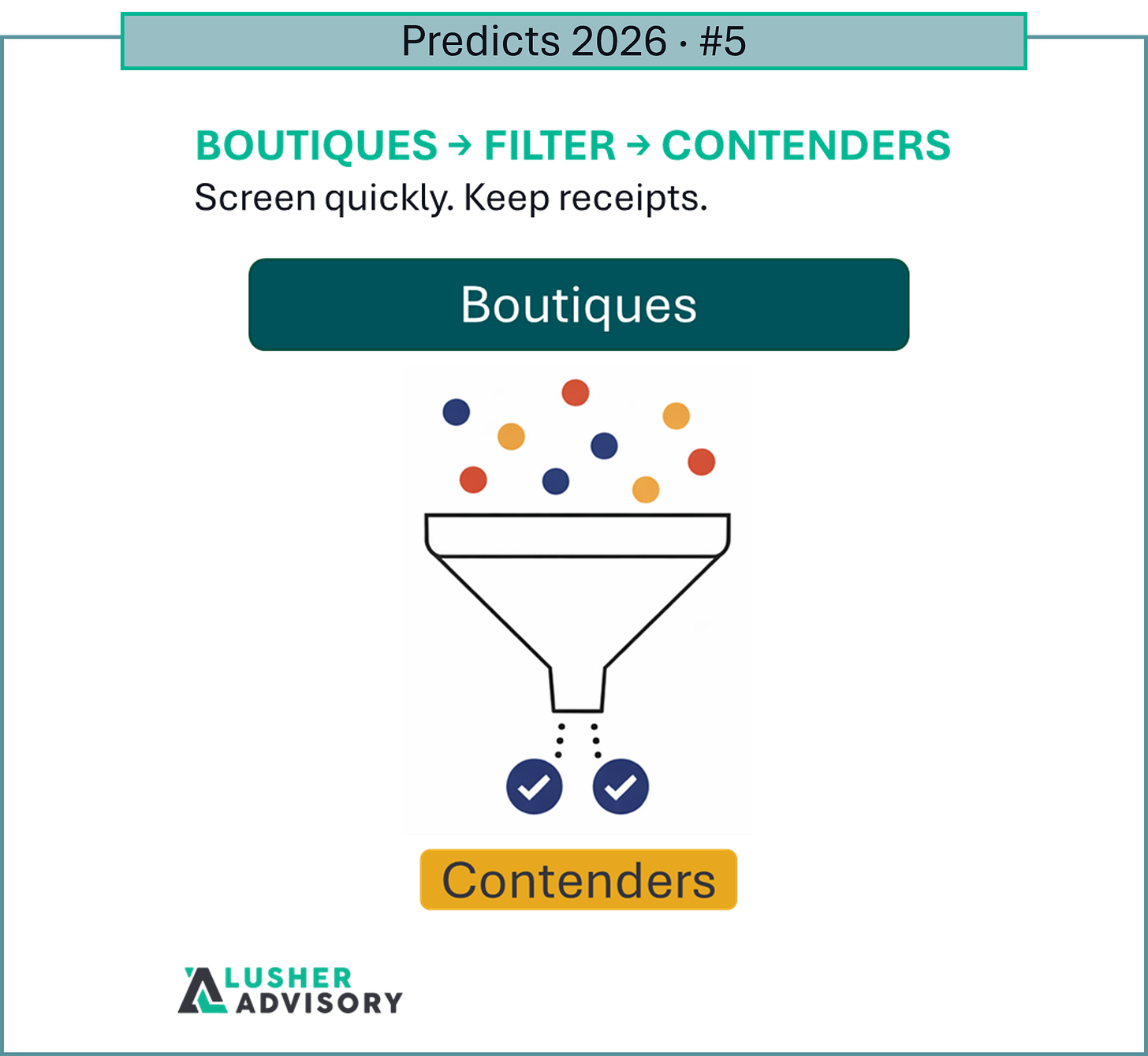
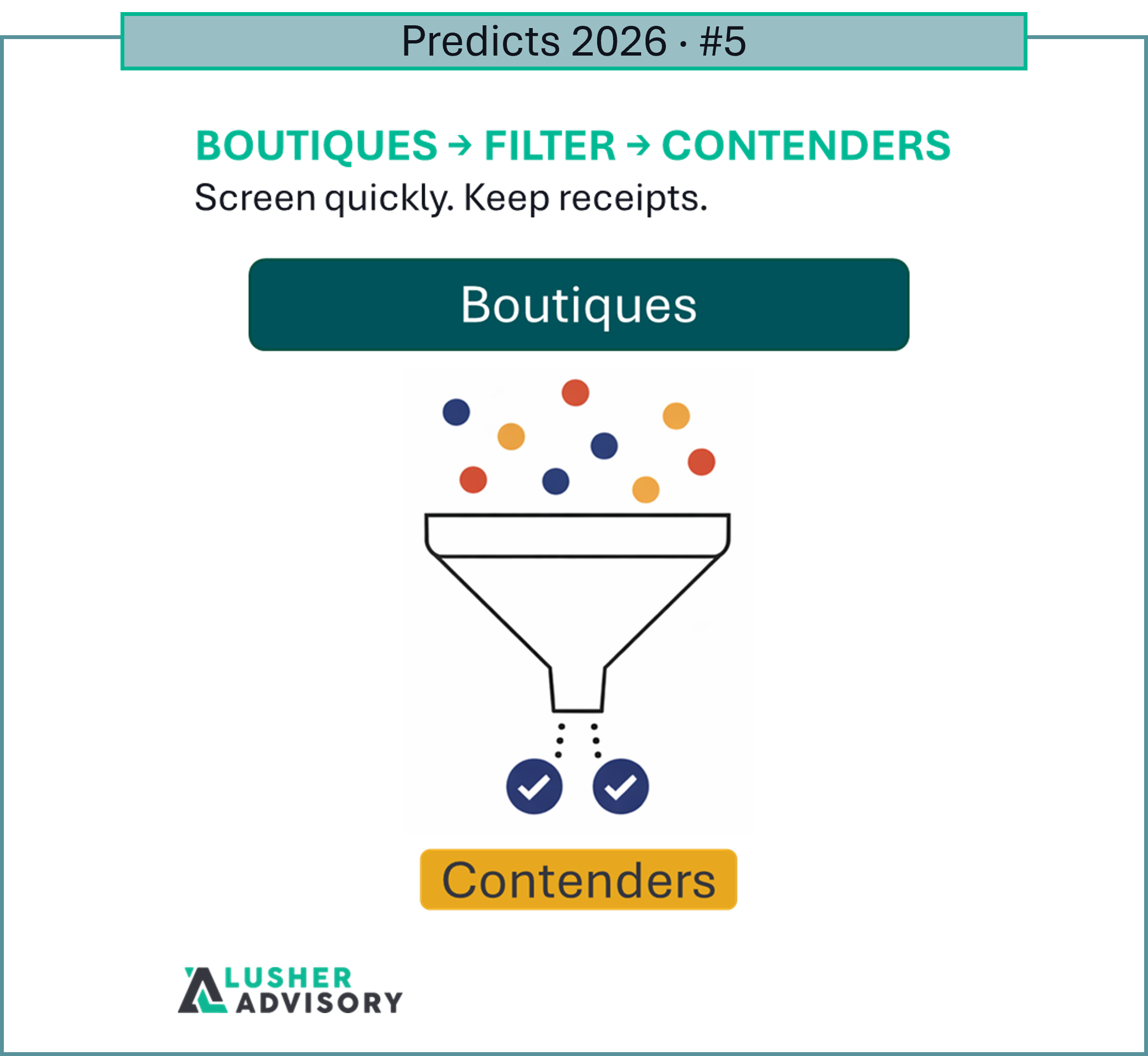
Definitions: Note 2 for the definition of “boutique” in the context of this research note. Note 3 for differences between influential analysts vs. smart advisors vs. whitepaper-for-hire.
Why the gap widens in 2026:
In a live poll from the Analyst News Roundup: 3Q25 webinar (n=74 selections), “perceived credibility or influence concerns” was the top reason AR professionals don’t engage boutique firms.
In a live poll from the Analyst News Roundup: 3Q25 webinar (n=74 selections), “perceived credibility or influence concerns” was the top reason AR professionals don’t engage boutique firms.
That skepticism becomes a sharper sorting mechanism in 2026, because:
AI commoditizes “smart takes” - Any LLM can generate plausible industry analysis. Differentiation now requires proprietary data, documented methodology, and verifiable buyer impact.
Budgets demand outcomes - With economic pressure, AR programs double down on firms that demonstrably move deals. Nice research that doesn’t shape shortlists gets cut
The attention environment is brutal – Attention is scarce; Contenders win by packaging, cadence, and distribution making their work easy to consume and reuse internally.
Impact is increasingly measurable - Vendors demand proof: Are you cited in RFPs? Do procurement teams use your frameworks? Can you show decision influence beyond vendor references?
Bottom line: in 2026, buyers (and AR teams) decide faster who is credible, consistent, and worth renewing because output is abundant and verification is scarce.
The Dividing Line: Operating Maturity vs. Founder Charisma
Contenders build an engine for systematic MI⁴; pretenders publish ad-hoc commentary.
Contenders demonstrate:
Leverage multiple AI technologies, generate unique/in-depth research and market data, and build a tech-buyer client base for direct influence. They also invest in visibility and growth—press quotes, speaking, events, and consistent publication—to develop clout over time
Documented research methodology (transparent criteria, scoring, sample design)
Editorial discipline / quality control; consistent cadence
Buyer influence evidence (cited in procurement docs, shapes RFP criteria, named in buyer surveys)
Team depth beyond the founder (bench strength, onboarding process)
Productized offerings (not just bespoke consulting)
Leveraging AI for client-facing deliverables and analyst research execution
Go-to-market investment and formal sales forces
Answer Engine Optimization (AEO)
Externally: Structures research so public answer engines (e.g., ChatGPT) can understand it, chunk it, and cite it as an authoritative source—so the firm shows up in AI-generated answers instead of being bypassed for more “machine-consumable” commentary or open hot takes. Concurrently, protects proprietary data and insights to avoid becoming a commoditized “smart take.”
Internally (client-side): Deliberately formats, tags, and packages deliverables so clients’ own AI systems can ingest, index, and reuse the work inside their knowledge bases and copilots, without flattening it into generic “smart takes.”
In plain terms: Contenders design their research to be cite-able externally and retrievable internally—becoming canonical sources in AI ecosystems while preserving scarcity around their highest-value insights.
For AR, this becomes a new screening signal: contenders ship research that can be reused by your internal AI, not just read once by a human.
Pretenders show:
Often former big-firm analysts transitioning to a “lifestyle” business; limited new research; heavy opinion output; low-to-nonexistent direct tech-buyer influence. More broadly: coasting on prior reputation, rehashing old work, and failing to generate new business, research, and ideas.
Heavy social media presence, thin formal research publication output
Differentiation by adjectives (”deep,” “unique,” “unbiased”) not proof
Founder bottleneck - everything routes through one person
Vendor-only revenue with no buyer validation
Inconsistent publishing (bursts then silence)
Methodology gaps (can’t explain their research process)
AR Intelligence is a reader-supported publication. To support my future research, consider becoming a paid subscriber. $8/month, $80/annual, team discounts available.
History repeats: from “Altimeter Envy” to “AI Envy”
This dynamic isn’t new. In 2009–2010, “supergroup” boutiques (Altimeter as the canonical example) created intense buzz by combining major-firm credibility with aggressive social and media distribution… triggering waves of copycats (“Altimeter Envy”).
Predicts 2026: we’re entering AI Envy. The contenders will use AI to build research engines and buyer-facing products; the pretenders will imitate the aesthetics (volume, hot takes, “AI-first” branding) without the infrastructure or expertise.
What AR Must Do in Q1 2026: Defensible triage + Strategic bets
Your goal isn’t to “engage boutiques.” Your goal is to systematically identify influence and allocate scarce attention accordingly.
Install a fast filter for “unknown boutique” requests. Require basic context up front (audience, methodology, and evidence of buyer relevance)—otherwise default to “no.”
Update analyst list management (ranking, tiering, service levels). Make engagement intentional and repeatable, not reactive to squeaky wheels.
Track new credibility markers. Methodology transparency, publishing cadence, and verifiable buyer influence are the new minimum bar.
Audit your boutique portfolio (then reallocate). Identify a short list of contenders per category; spend less time on the rest.
Invest early in contenders. Small actions (responsiveness, access, visibility) can compound as contenders build buyer gravity.
Reallocate budget strategically. Fund contenders; stop subsidizing noise.
For detail and related actionable advice see AR Playbook: Strategic Analyst Lists - Incorporating Boutiques.
What Boutiques Should Do in 2026 to Avoid Being Squeezed
Written for boutique leaders - but it’s also the quiet message AR teams need to hear: the contenders will look and operate differently. And if you’re unsure where a firm lands, that’s exactly where a 2026 strategic analyst list methodology refresh comes into play.
Boutiques are getting squeezed from both sides. On one side, AI makes “good enough” content cheap. On the other, AR and buyers are tightening attention and credibility thresholds. In 2026, the boutiques that win won’t be the loudest. They’ll be the ones that build a repeatable influence engine.
Declare your model. “Boutique firm” or “independent practice” - don’t sell one and operate the other.
Prove influence. Method + buyer proof beats “thought leadership” every time.
Build repeatability. Cadence, editorial discipline, and verification are the new credibility floor.
Stop taxing vendors. If your ask feels like admin with unclear buyer impact, AR will ignore it.
Productize + instrument. One clear offer, easy tiering, AI as ops leverage, and evidence your work changes decisions.
Want to go deeper? See “Contender or Pretender? The Boutique Playbook for 2026” for actionable advice, a practical framework, checklists, and a scorecard.
The not-so-quiet takeaway for AR leaders
If a boutique can’t show method, proof, cadence, and buyer gravity, it’s rational to deprioritize them… even if they’re loud on LinkedIn, X, or Bluesky. The boutiques that survive 2026 will look more like disciplined research businesses, and less like personality-driven publishing.
AR Intelligence: Conclusion
In 2026, “boutique analyst” stops being a meaningful category. The long tail is too large, and AI makes surface-level output too easy. AR leaders will increasingly sort small firms into contenders (with a research engine and buyer influence) and pretenders (with visibility but weak influence verification).
The winning move isn’t chasing squeaky wheels. It’s building a defensible filter—then concentrating attention on the boutiques that can truly expand your MI⁴ outcomes and strengthen your negotiation leverage.
Notes
Note 1 - Predicts 2026: How to Read This Series
Predicts 2026 is a research series examining the structural shifts reshaping the analyst ecosystem -- not as isolated trends, but as interconnected forces that will define how analyst firms, AR teams, and research consumers operate in the year ahead.
Each note focuses on a specific signal -- a market behavior, operating change, or economic pressure -- that looks incremental on its own, but becomes consequential when viewed as part of a broader system-level transition.
The notes are designed to be read independently, but together they form a coherent picture of how analyst research, access models, influence, and economics are evolving in an AI-mediated world.
The list below tracks the published Predicts 2026 notes to date and will be updated as new signals are added.
Predicts 2026: AI + Aggressive Firms + End Users = Pricing Pressure
Predicts 2026: The Collapse of “Draft Review” and the Rise of Individualized Research Access
Predicts 2026: The Gap Widens Between Boutique Contenders and Pretenders (this note)
Note 2 – Definition: Boutique
This research note uses “boutiques” as a catch-all label for analyst firms smaller than the traditional Big 3 (Forrester, Gartner, IDC) and mid-sized firms with approximately 100 analysts (e.g., Info-Tech Research, Omdia, QKS Group, Verdantix). That includes solo practitioners, small multi-analyst boutiques, specialty coverage firms, regional firms, research collectives/partner networks, and advisory-led micro-firms that may publish selectively. According to the ARInsights ARchitech analyst database there are more than 1,000 firms and solo practitioners that fit this definition of boutique.
Note 3: Influential Analysts vs. Smart Advisors vs. Whitepaper-for-Hire
This Predicts is focused on helping AR identify boutiques who are influential in shaping market narratives and tech buyer decisions—not merely helpful or visible.
Influential Analysts (what this Predicts prioritizes): demonstrate buyer gravity through verifiable mechanisms—e.g., shaping RFP criteria, being cited in procurement artifacts, and bringing data that withstands scrutiny.
Smart Advisors (valuable, but not always influential): may deliver real client value via inquiry, coaching, and expert guidance, even if they don’t move broader market perception or buyer shortlists. (This note does not denigrate that work.)
Whitepaper-for-Hire: can be useful for marketing and sales enablement, but typically does not function as independent market influence—so it should be managed differently in analyst lists and engagement models.
This research note is not meant to denigrate analysts who are smart, credible advisors and create real client value but who don’t meaningfully influence broader market perception or buyer shortlists.
Separately, whitepaper-for-hire research providers can be useful for marketing content and sales enablement, but they rarely function as independent market influencers.
Smart Advisors and Whitepaper-for-Hire should be managed accordingly in analyst lists and engagement models – including delegating to others, e.g., competitive intelligence, marketing, and executive strategy.
Turn Predicts into Advantage
Predicts 2026 surfaces the structural shifts reshaping the analyst ecosystem. Acting on them requires deeper analysis — and, in many cases, real-time conversations.
Paid AR Intelligence subscribers get execution-focused research, frameworks, and follow-on analysis designed to help confirm priorities, reduce risk, and stay ahead of analyst-firm change.
Advisory and inquiry-by-the-hour engagements are available for organizations that want to pressure-test strategy, redesign workflows, or translate these signals into concrete decisions for 2026.
→ Subscribe to AR Intelligence ($8/month, $80/year, team discounts available)
→ Explore Inquiry-by-the-Hour or Research & Advisory Services
Independent by design. Member support makes this work possible.
To learn more: Sales@LusherAdvisory.com
© 2025-2026 Lusher Advisory, LLC. All Rights Reserved.
This report is copyrighted by Lusher Advisory. Unauthorized distribution or reproduction is prohibited. To license this report for broader use, including sharing with clients, prospects, or internal teams, contact Lusher Advisory at Reprint@LusherAdvisory.com
This is exactly the triage framework AR teams need! The distinction between contenders with documented methodolgy and pretenders with just social noise really resonates with my experience evaluating research partners. I've seen too many firms that sound good on paper but cant demonstrate actual buyer influence when you dig deeper. Your point about measuring impact through procurement artifacts rather than LinkedIn followers is spot-on.